Quick Answer
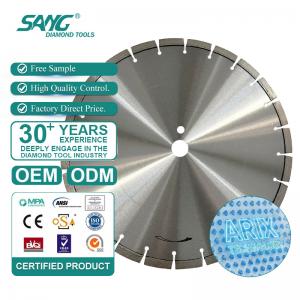
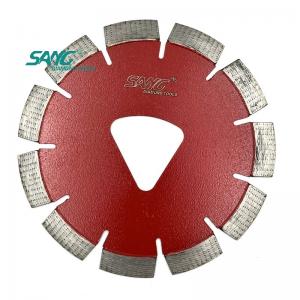
What is it? The SANG Turbo V-Slot blade is a laser-welded diamond cutting disc for angle grinders, available from 115mm (4½") to 230mm (9"), engineered for fast dry cutting of concrete, brick, block and masonry.
Why it matters: The segment rim combines a turbo profile with open V-shaped gullets. The V-slots pull cool air into the kerf and eject slurry-free dust on every rotation, so the blade runs cooler in dry cutting — the single biggest cause of premature blade death on site. Segments are bonded by automated laser welding at over 1,500 °C, forming a metallurgical (atomic diffusion) joint rather than a brazed copper filler layer. That is what makes high-RPM dry cutting safe and eliminates segment loss when the blade contacts light rebar, wall ties or mortar-embedded steel.
Who should buy it: Contractors cutting block walls, brick, pavers, roof tiles, screed and cured concrete where no water supply is available; distributors needing a fast-moving, five-diameter angle-grinder range under one bond family; procurement teams that measure cost per linear metre, not unit price.
Key spec at a glance: Ø115 / 125 / 150 / 180 / 230mm · 22.23mm bore (M14 available) · 10–12mm segment height · 65Mn hardened steel core · dry cutting primary, wet cutting permitted · manufactured and speed-tested to EN 13236.
1. Product Overview
Most angle-grinder blades fail for one reason: heat. In dry cutting there is no water to carry heat away, so the steel core expands unevenly, the tension ring relaxes, the blade starts to wander, and finally the bond softens and a segment lets go. Everything in this blade is designed around that single failure mode.
The Turbo V-Slot rim is not a cosmetic pattern. Each segment carries a V-shaped relief slot cut into the turbo waveform. As the blade spins, the open V acts as a small centrifugal fan: air enters at the slot root, travels along the wave, and exits at the outer edge carrying concrete fines with it. Two things follow — the segment sheds heat continuously, and the kerf stays clear so the diamonds keep biting fresh material instead of grinding through their own dust.
The laser-welded bond does the rest. SANG welds every segment on fully automated laser lines. The weld seam is a fused metallurgical zone between segment and steel core, not a brazed sandwich. A brazed joint depends on a separate filler alloy layer, and its strength falls away sharply as the joint approaches the filler's own melting range — roughly 600–700 °C for the copper- and silver-based fillers used in this class of tool. A 9" blade in a sustained dry block-cutting run can drive the segment interface into exactly that window. A laser weld has no filler layer to lose: its failure threshold is governed by the fused parent metals themselves. That is why laser welding is a safety requirement, not an upgrade, for any blade sold for dry use on a hand-held grinder.
Bottom line for the buyer: one blade family, five diameters, one bond logic — dry-first, heat-managed, laser-welded.
2. Real-World Case Studies
The cases below are drawn from SANG OEM and project supply work. Volumes and diameters are as recorded; performance figures are averages across the batch, and site conditions can shift results by roughly ±30%.
Case 1 — Block Wall Openings on a Residential Retrofit, Middle East
Situation. A finishing contractor was cutting door and service openings in 150mm hollow concrete block across 60 apartments. Water was not permitted inside finished units, so every cut was dry. Their existing 230mm brazed-rim discs were losing segments after 8–10 openings, and two near-miss incidents had already been logged by the site safety officer.
What changed. They moved to TVS-23012 in bond grade A (block is soft but highly abrasive) on 2,400 W grinders, with the operator instructed to plunge in two passes rather than forcing full depth.
Result.
Zero segment losses across the 60-unit programme
Average 41 openings per blade, against 8–10 previously
Cutting time per opening dropped from roughly 9 minutes to under 6, mostly because the crew stopped needing cool-down pauses
Safety officer closed the open observation on abrasive-disc failures
Case 2 — Private-Label Range for a European Distributor
Situation. A builders' merchant group in Europe wanted to replace an imported five-size angle-grinder blade range. Their complaint about the previous supplier was not performance — it was inconsistency: returns clustered in specific batches, and the 125mm size wandered on cut lines.
What changed. SANG supplied the full 115 / 125 / 150 / 180 / 230mm Turbo V-Slot range under the customer's own label, with three controls written into the supply agreement: laser weld on 100% of segments, tension-levelling with a runout check on every blade, and a retained sample plus batch code for every production lot.
Result.
Warranty return rate fell from 2.8% to 0.4% over the first four quarters
Line-of-cut complaints on the 125mm SKU stopped entirely after tension-levelling was tightened
The group extended the programme to a second brand tier the following year
Case 3 — Municipal Repair Crew, Paver and Kerb Trimming
Situation. A city maintenance crew trimming concrete pavers and kerb units worked from a van with no water tank. Their pain point was not blade life but cut quality — chipped paver edges meant reworking visible surfaces in a conservation district.
What changed. TVS-15010, bond M, chosen for the turbo waveform's cleaner edge, with a scoring pass at 5mm by a full-depth pass.
Result.
Visible edge chipping dropped sharply; rework on trimmed units fell from around 1 in 6 to under 1 in 30
Blade life averaged 310 linear metres across mixed paver and kerb work
The two-pass method was written into the crew's standard work instruction
3. On-Site Operating Guide
Before the cut
Check the blade body for cracks, bends or missing segments. Reject anything damaged — no exceptions.
Confirm the max rpm marked on the blade is equal to or higher than the grinder's no-load speed.
Mount with the rotation arrow matching the tool, flanges clean and fully tightened.
Fit the guard. A laser-welded blade is safe; an unguarded grinder is not.
During the cut 5. Dry cutting rhythm: cut for 30–60 seconds, then lift the blade and let it spin free in air for 10–15 seconds. The V-slots cool fastest when unloaded — this one habit is worth more blade life than any other single factor. 6. Let the blade cut. Pushing harder does not cut faster; it heats the core and rounds off the segment. 7. Never twist or lever the blade sideways in the kerf. Lateral load is what breaks steel cores. 8. For depths above roughly one-third of blade radius, use progressive passes rather than one full plunge. 9. If cutting slows and the segment looks polished, dress it with two or three cuts in abrasive material (sand-lime brick, an old concrete block) to re-expose the diamond.
Dust 10. Dry cutting concrete and masonry generates respirable crystalline silica. Use on-tool extraction with an M-class or H-class vacuum, plus respiratory protection appropriate to local regulation.
4. Frequently Asked Questions
Q1. What is a Turbo V-Slot diamond blade, and how is it different from a normal turbo blade?
A Turbo V-Slot blade is a segmented diamond blade whose turbo waveform is interrupted by open V-shaped gullets. A normal turbo rim is continuous or has narrow straight slots; the V opens outward, so it drives an air current through the kerf during rotation. The practical difference shows up in dry cutting: lower segment temperature, less clogging in block and AAC, and a longer usable run between cool-down pauses.
Q2. Can I really dry cut concrete with this blade, or do I need water?
Yes — dry cutting is the primary design case. The laser-welded joint tolerates the temperatures generated in dry cutting, which brazed discs do not. Wet cutting is also permitted and will extend segment life further where water is available, but nothing about the blade requires it.
Q3. Will it cut rebar?
It cuts light embedded steel — wall ties, mesh, small-diameter starter bars encountered incidentally — provided you keep a steady feed and do not rock the blade. It is not a rebar-cutting tool. For heavily reinforced structural concrete, move to a larger laser-welded blade on a cut-off saw or use a wall saw.
Q4. Which diameter do I need?
Match diameter to required depth: a grinder can cut roughly (diameter ÷ 2) minus flange and guard clearance. That is about 30mm at 115mm and 78mm at 230mm. See the diameter table in section 4.2. If you need more depth than a 230mm blade gives, the answer is a different machine, not a bigger disc on a grinder.
Q5. What bore sizes are available?
Standard bore is 22.23mm (⅞"), which fits the great majority of angle grinders worldwide. M14 threaded hub and 20mm bore versions are produced on request. Adapter rings are not supplied by default — specify the bore you need at order stage.
Q6. How long does one blade last?
Life depends far more on material and operator technique than on the blade. As a working reference for a 125mm blade under normal conditions: roughly 150–250 linear metres in clay brick, 200–350 m in block, 80–150 m in cured C30 concrete. Expect ±30% variation between sites. Ask for the bond grade matched to your material and the range narrows.
Q7. Why does my blade cut fast at first and then slow down?
The segment has glazed — the metal bond has smeared over the diamond crystals instead of wearing back to expose new ones. It is usually a sign the bond is too hard for the material, or that feed pressure was too light. Dress the blade in an abrasive material to re-open it, and for the next order specify a softer bond grade for that job type.
Q8. Is laser welding really necessary, or is brazed good enough?
For a hand-held grinder used dry, laser welding is a safety requirement. A brazed joint relies on a separate filler-alloy layer, and that layer's load-bearing strength drops steeply as the interface approaches its melting range — around 600–700 °C for the fillers used in this tool class. Sustained dry cutting on a 180mm or 230mm blade can reach that window. Laser welding fuses segment and core with no filler layer in between, so the joint's failure threshold is set by the parent metals rather than by a low-melting-point interlayer.
Q9. Do the blades meet European safety requirements?
The range is manufactured, balanced and speed-tested to EN 13236, the safety standard for superabrasive products, and every blade is laser-marked with diameter, bore, maximum operating speed and rotation direction. Documentation for specific market approvals can be issued with the order — tell us the destination market at quotation stage.
Q10. Can I get OEM / private label, and what is the MOQ?
Yes. SANG runs private-label programmes for distributors and brand owners: your logo on the blade body, your artwork on the box, your own SKU coding and batch traceability. Bond formulation, segment height and segment count can be tuned to your market. MOQ is agreed per diameter and artwork setup — contact the sales team with your size mix for a volume-based quotation.
Q11. What lead time should I plan for?
Standard diameters in stock bond grades typically ship within 7–15 days. Custom bond formulations, non-standard bores or full private-label runs typically require 20–30 days including artwork approval. Container-load orders are planned against a confirmed production slot.
Q12. Can you recommend a bond if I don't know my aggregate?
Send the concrete grade, the aggregate type if known, and a photo of a cut face or a used blade. Our engineers read wear patterns routinely — a worn segment tells us more about your site than a spec sheet does. Sample blades can be issued for qualified buyers to validate before a volume order.
5. Why Partner with SANG Diamond Tools
SANG Diamond Tools — A Legacy of Leadership Since 1993
Top 10 Industry Leader Established in 1993, SANG is recognised as a Top 10 Manufacturer in China's diamond tool industry. With an annual tax contribution reaching millions, we are a fiscally strong and reliable partner you can trust for long-term supply.
Scientific Innovation (PhD R&D Team) Innovation is in our DNA. Our R&D centre is led by multiple PhDs from prestigious universities, focusing on molecular-level bond design. We don't just sell tools; we provide Exclusive Construction Solutions tailored to your specific job site challenges — which is why our bond matrix for abrasive block differs from the one we ship for granite-aggregate concrete.
Large-Scale Production & Capacity With a workforce of 50+ dedicated workshop employees, SANG operates high-capacity automated production lines. We guarantee short lead times and the ability to fulfil container-load orders without compromising quality. Every segment in this range is laser-welded on automated lines under batch traceability.
Globally Validated Quality We hold numerous national industry patents and a comprehensive range of international certificates for our diamond saw blades and grinding tools. Our quality is validated by the most stringent markets in North America and Europe.
Professional Multilingual Communication Communication is the key to successful partnership. Our sales team consists entirely of English Major (TEM-8) graduates. Furthermore, we offer support in various minority languages — including French, Persian and Spanish — ensuring zero-barrier communication and precise requirement handling.
On-Site & Remote Technical Support We stand behind our products. Our technical engineers offer both online video consultations and offline on-site support to assist with machine calibration, tooling selection and troubleshooting at your project site.
When you choose SANG, you are not just buying diamond tools; you are partnering with a 30+ year industry powerhouse dedicated to your project's success.
6. Key Takeaways
Dry cutting is a heat problem, and the V-slot is the heat answer. Open V gullets drive airflow through the kerf on every rotation, keeping segment temperature down and the cut clear of packed dust.
Laser welding is a safety line, not a marketing line. A brazed joint loses strength as its filler layer approaches 600–700 °C, and sustained dry cutting on a large grinder blade reaches that window. Every segment in this range is laser-welded at over 1,500 °C, with no filler interlayer to fail.
Five diameters, one bond logic. 115 / 125 / 150 / 180 / 230mm covers chasing, brick, block openings and screed from a single supplier relationship, with bond grades M / H / A matched to material rather than sold as one universal disc.
Match the bond to the material, not to the price. Abrasive block eats a standard bond; hard aggregate glazes a soft one. Getting this right typically matters more to cost per metre than any other decision.
Field evidence, not claims. Zero segment losses over a 60-unit dry block programme, a distributor return rate down from 2.8% to 0.4%, and paver rework cut from 1-in-6 to under 1-in-30 — the pattern across cases is consistency, not one heroic number.
Technique multiplies tool value. The 30–60 second cut / 10–15 second free-spin rhythm, no lateral twisting, and progressive passes will change your blade life more than switching brands will.
The factory behind the blade decides batch consistency. A 1993-founded manufacturer with PhD-led bond R&D, automated laser welding and 100% speed testing is what turns a good specification into a repeatable delivery.
7. Request a Quote or Sample
Every site is different — aggregate hardness, block type, tool power and dust regulation all move the result. We don't quote one disc for every job.
Tell us three things and we'll come back with a specification, not a catalogue page:
What you are cutting (material, grade, thickness)
Which grinders your crews run (diameter, wattage, bore)
Your annual or per-order volume and target market
Available on request: free samples for qualified buyers · OEM / private-label programmes · custom bore, segment height and bond formulation · engineer-to-engineer technical review of your current blade wear.
Email: info@sangtools.com Tel / WhatsApp: +86-595-22699555 Website: www.sangtools.com


 English
 فارسی
 français
 русский
 italiano
 español
 português
 العربية
 Polski
 Indonesia
 românesc
 中文