
Best Laser Welded ARIX Diamond Core Drill Bit for Reinforced Concrete | SANG Diamond Tools
Discover how laser welded ARIX diamond core drill bits improve drilling speed, lifespan, and safety in reinforced concrete. Learn how to choose the right core bit from SANG — 30+ years of manufacturing expertise, trusted in 75+ countries.
What Is the Best Laser Welded ARIX Diamond Core Drill Bit for Reinforced Concrete? A Complete Buyer's Guide
By SANG Diamond Tools Technical Team | Est. 1993 | Top 10 Manufacturer in China | Trusted in 75+ Countries
Quick Answer
If you're a procurement manager, contractor, or distributor evaluating core drill bits for reinforced concrete, here's what you need to know upfront:
| Selection Criteria | Recommended Answer |
| Best segment technology | ARIX array-pattern diamond distribution |
| Best bonding method | Laser welding (not silver brazing) |
| Dry or wet cutting? | Both — dual-rated bits available |
| Can it drill through rebar? | Yes — ARIX maintains stable cutting through steel reinforcement |
| Who is it best for? | Contractors, distributors, rental companies, infrastructure procurement |
| Cost advantage | Higher unit price, lower cost per hole drilled |
| Failure Mode | Root Cause | Impact on Project |
| Segment glazing | Bond too hard for concrete hardness | Drilling stops entirely — must re-dress or replace |
| Rebar impact fracture | Silver-brazed bond cannot absorb shock | Segment detachment — safety incident |
| Thermal delamination | Heat exceeds brazed joint tolerance (~650°C) | Segment loss mid-hole — borehole damage |
| Bit vibration / drift | Uneven segment wear, unbalanced cutting | Hole deviation — structural non-compliance |
| Premature diamond burial | Random distribution leaves inactive zones | Slow drilling, high cost per hole |
| Core barrel warping | Thin-wall barrel under continuous rebar impact | Bit seizure in borehole — extraction cost |
What Is ARIX Technology? The Engineering Behind the Performance
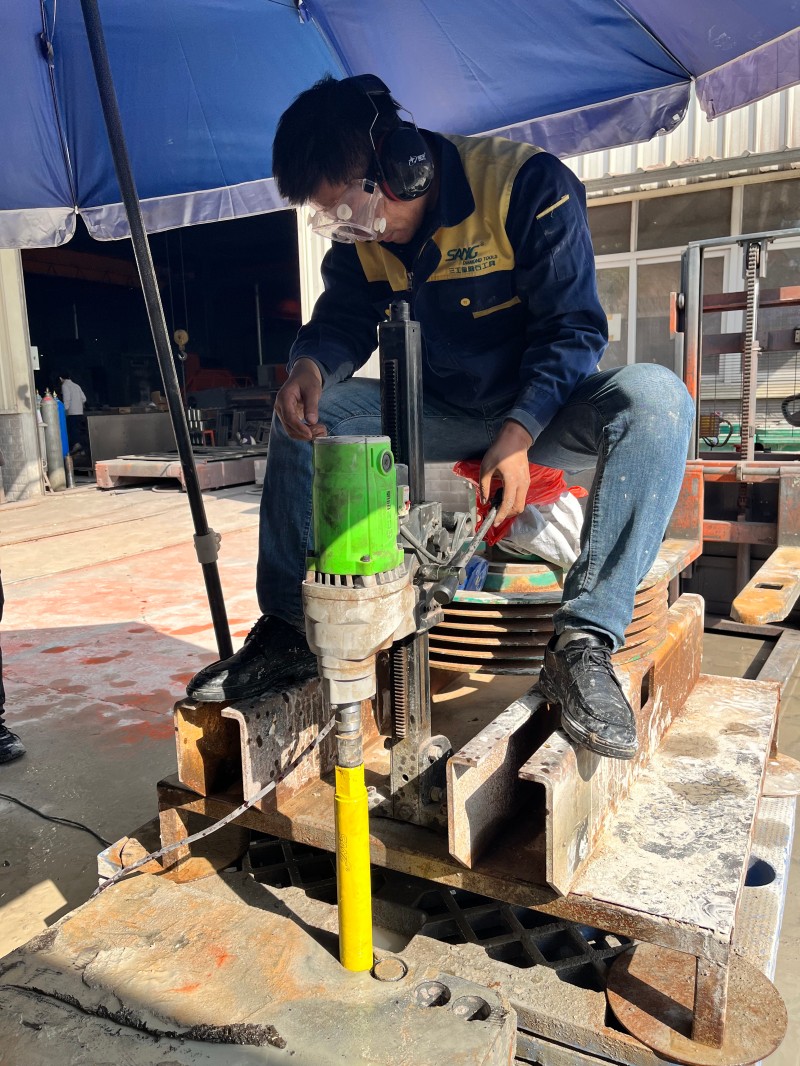
ARIX (Array Pattern) technology is a diamond placement methodology that positions individual diamond crystals in a precise, repeating three-dimensional geometric matrix within the metal bond segment — rather than the random distribution used in conventional segments.
Random vs. ARIX: A Side-by-Side Comparison
| Performance Factor | Conventional Random Segment | ARIX Array Pattern Segment |
| Diamond placement | Irregular, clustered in zones | Precise geometric array, uniform spacing |
| Active cutting diamonds per pass | Variable — depends on which diamonds surface | Consistent — geometry guarantees exposure |
| Drilling speed | Medium, inconsistent | High, stable throughout tool life |
| Segment wear pattern | Uneven — causes vibration and drift | Uniform — maintains rotational balance |
| Rebar performance | Speed drops sharply at steel contact | Stable cutting rhythm maintained |
| Heat management | Localized hotspots at diamond clusters | Distributed — no single thermal concentration point |
| Tool lifespan vs. standard | Baseline | 30–50% longer |
| Cost per hole drilled | Higher | Significantly lower |
| Hole wall quality | Standard roughness | Smoother bore wall |
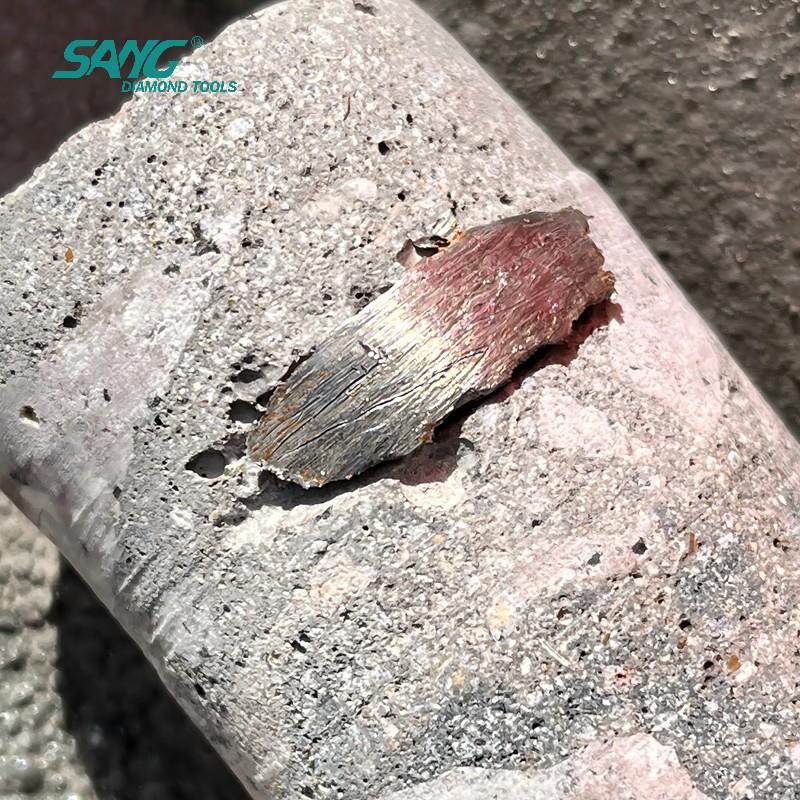
Why geometry matters at the microscopic level: Each diamond crystal in an ARIX segment has a defined neighborhood of bond matrix around it. When the segment contacts rebar, the impact load is distributed across multiple crystals simultaneously — no single crystal absorbs full shock. This is the physical reason ARIX bits survive rebar contact that destroys conventional segments.
SANG Engineering Note: SANG's PhD research team developed the ARIX matrix spacing specifically calibrated for the concrete density ranges and rebar configurations specified in ACI 318 (North America) and Eurocode 2 (Europe). The bond formulation is not adapted from a generic catalog — it is application-engineered for the markets where our customers operate.
Product Specifications: SANG Laser-Welded ARIX Core Drill Bit
| Specification | Standard Options | Custom Available |
| Segment technology | ARIX array pattern, premium industrial diamond | Custom diamond grade on request |
| Welding method | High-precision laser welding | — |
| Cutting mode | Dry & Wet (dual-rated) | — |
| Diameter range | 14mm – 300mm | Beyond 300mm on request |
| Connection types | 1/2" Gas (BSP), 5/8"-18 UNC, 1-1/4" UNC, SDS-Max, SDS-Plus, M22 | Non-standard threads on request |
| Barrel lengths | 300mm / 400mm / 450mm / 500mm/ 600mm | Extended lengths on request |
| Segment height | 10mm / 11mm / 12mm | Application-matched on request |
| Bond hardness | Soft / Medium / Hard | Custom formulation for specific concrete grades |
| Target material | Reinforced concrete, rebar-dense structures, hard aggregate | — |
| Certifications | ISO 9001, CE, National Industry Patents (CN) | — |
| OEM / Private label | Available | Contact SANG sales team |
Selecting the Right Specification: A Step-by-Step Framework
Step 1 — Define Your Hole Diameter
| Diameter | Typical Application |
| 32mm | Plumbing pipe penetrations, anchor bolts |
| 52mm | Electrical conduit, small HVAC penetrations |
| 82mm | Medium HVAC, structural anchor drilling |
| 102mm | Large conduit, utility penetrations |
| 152mm | Major HVAC, significant structural openings |
| 202mm+ | Infrastructure, bridge deck penetrations |
Step 2 — Define Your Concrete Specification
| Concrete Grade | Recommended Bond |
| C20–C30 (residential) | Hard bond segment |
| C30–C40 (commercial) | Medium bond segment |
| C40–C50 (industrial / infrastructure) | Soft-medium bond, ARIX reinforced |
| C50+ (bridge / tunnel) | Contact SANG engineering for custom bond formulation |
Step 3 — Define Your Drilling Mode
| Mode | When to Choose | Key Requirements |
| Dry | No water access, indoor renovation, electrical rooms | Dust extraction mandatory; thermal rest cycles required |
| Wet | Maximum tool life, high rebar density, C40+ concrete | Clean water at 2–4 L/min; flush every 150mm |
| Dual-rated | Mixed job site conditions | SANG standard ARIX specification |
| Connection Type | Compatible Equipment |
| 1/2" Gas (BSP) | Core drilling rigs, wall saws |
| 1-1/4" UNC | North American rig-mounted systems |
| SDS-Max | Professional rotary hammer drills (≥ 5kg class) |
| SDS-Plus | Medium-duty rotary hammers |
| M22 | European handheld core drills |
Dry Cutting vs. Wet Cutting: Operational Guide
Dry Cutting
Best for: Indoor renovation, upper floors, confined spaces, electrical rooms, data centers, post-tensioned slabs where water is prohibited.
Operational requirements:
1.Vacuum dust extraction is mandatory — silica dust regulations apply globally (OSHA 29 CFR 1926.1153 / EU Directive 2017/164)
2.Apply thermal rest intervals: 30 seconds cutting, 10 seconds retraction for airflow cooling
3.Do not exceed the diameter-rated maximum RPM — dry heat accumulates significantly faster than wet
Performance expectation: 10–20% shorter tool life vs. wet cutting in identical concrete. Acceptable when water access is not available.
Wet Cutting
Best for: Maximum tool life per unit, high rebar density (3+ bars per borehole), consecutive large-diameter holes (>100mm), C40+ concrete.
Operational requirements:
1.Maintain continuous water flow at 2–4 L/min throughout drilling
2.Use clean water supply — recirculated contaminated slurry accelerates segment wear by up to 40%
3.Flush borehole every 150mm depth to clear accumulated swarf and prevent bit seizure
Real Application Case: Infrastructure Bridge Deck Drilling
Project profile:
1.Post-tensioned reinforced bridge deck, C45 specification
2.Dense rebar grid, 28mm diameter bars at 150mm spacing
3.Requirement: 102mm diameter × 350mm depth penetrations, 180 holes total
4.Previous tooling: Silver-brazed conventional core bits
| Performance Metric | High frequency welding Conventional | SANG ARIX Laser-Welded |
| Holes completed per bit | 10 | 28 |
| Segment detachment incidents | 3 per 60 holes | 0 |
| Average time per hole | 5.8 minutes | 3.9 minutes |
| Total bits consumed (180 holes) | 18 | 7 |
| Unplanned stoppages | Frequent | None |
| Estimated total tool cost saving | Baseline | ~61% reduction |
"We were replacing bits every half day. After switching to SANG ARIX bits, we finished the full 180-hole program with 7 bits and zero safety incidents. The consistency through the rebar grid was unlike anything we had used before." — Project Manager, Bridge Infrastructure Contractor
Why SANG: Supplier Evaluation for Procurement Managers
For procurement managers and distributors, tool performance is only part of the supplier evaluation. Supply reliability, technical capability, and communication quality determine whether a supplier relationship can scale to meet project demands.
SANG vs. Generic Suppliers: Complete Evaluation Matrix
| Evaluation Criteria | Generic Suppliers | SANG Diamond Tools |
| Years in operation | Variable / unverified | 30+ years (Est. 1993) |
| Industry ranking | Unknown | Top 10 Manufacturer in China |
| Financial stability | Unknown | Multi-million annual tax contributor |
| R&D capability | None / outsourced | In-house PhD team, molecular bond R&D |
| Production scale | Small batch | 50+ workers, automated lines, container-load ready |
| Quality certification | Basic | ISO 9001, CE, National Industry Patents |
| Export reach | Limited | 75+ countries — US, EU, AU, Middle East, Latin America |
| Language capability | Basic | English only TEM-8 English + French, Spanish, Persian & more |
| Technical support | Email only | Video consultation + on-site engineering |
| OEM / Custom capability | Rarely available | Full OEM/ODM, custom bond formulation |
| Sample availability | Inconsistent | 1–10 pcs sample orders supported |
| Batch consistency | Unverified | ISO 9001 governed, CoC available per batch |
Frequently Asked Questions
Q1: Can this bit drill through rebar without stopping?
Yes. ARIX technology is specifically designed to maintain stable cutting performance at the concrete-to-rebar transition. Unlike standard bits that lose speed or skip at rebar contact, ARIX geometric diamond placement distributes impact across multiple crystals, allowing continuous penetration.
Q2: Is laser welding actually stronger than silver brazing in practice?
Yes — measurably so. Laser welding produces a molecular fusion bond with tensile strength of 3,500–5,000 N, compared to 1,200–1,800 N for silver brazing. More importantly, laser welds maintain structural integrity at temperatures up to 900°C, which is critical during dry cutting or sustained rebar contact. Silver-brazed joints fail at approximately 650°C — well within the temperature range generated during normal reinforced concrete drilling.
Q3: What is the minimum order quantity for SANG ARIX core bits?
SANG supports sample orders of 1–10 pcs for field testing and evaluation, as well as full container-load bulk orders. Lead times are confirmed at order placement. Contact info@sangtools.com for formal quotation and sample arrangements.
Q4: Can SANG produce custom diameters or non-standard connection types?
Yes. With 31 years of OEM/ODM experience, SANG routinely produces custom specifications including non-catalog diameters, extended barrel lengths, and proprietary connection threads. Standard lead time for custom tooling is 15–25 working days depending on complexity.
Q5: How is batch-to-batch quality consistency guaranteed for large orders?
All production runs are governed by SANG's ISO 9001 Quality Management System. Each batch undergoes segment height verification, bond hardness testing, and laser weld integrity inspection before shipment. Certificate of Conformity is issued on request for each production batch.
Q6: How do I select the right bond hardness for my specific concrete?
Provide your concrete grade (MPa or PSI rating), aggregate type and maximum size, rebar density and diameter, and drilling machine power rating. SANG's technical team will issue a formal tooling recommendation — free of charge as a standard pre-order technical service.
Q7: How should diamond core bits be maintained to maximize service life?
Key maintenance practices: avoid excessive downward drilling pressure; maintain continuous water supply during wet cutting; allow thermal rest cycles during dry cutting; dress glazed segments promptly on a concrete block or dressing stick; store bits vertically in a dry environment; never use a bit rated below your machine's maximum RPM.
Q8: Does SANG support OEM / private label for distributors?
Yes. Full OEM service including custom packaging design, private label branding, and distributor-exclusive specifications is available. Minimum order quantities apply — contact the SANG sales team for a confidential OEM discussion.
Contact SANG Diamond Tools www.sangtools.com | info@sangtools.com Est. 1993 | Top 10 China Diamond Tool Manufacturer | 75+ Countries | ISO 9001 | CE Certified
24/7 via fax, email or phone.



 English
 فارسی
فارسی français
 русский
 italiano
 español
 português
 العربية
 Polski
 Indonesia
 românesc
 中文
中文