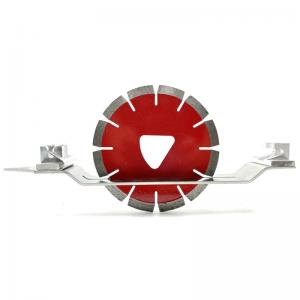
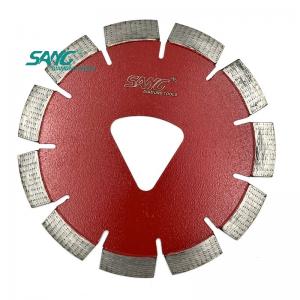
Product featured: SANG Vloerverwarming Floor Heating Cutter — 125mm / 130mm, 17mm thickness, diamond tuck point saw blade for concrete
Application: Concrete floor grooving (slot cutting) for hydronic underfloor heating pipes
Target users: Underfloor heating installers, concrete cutting contractors, renovation companies, MEP contractors, property developers

1) Background: Why Grooving Quality Matters in Underfloor Heating Projects
Across the Netherlands (NL) and Germany (DE), a large share of residential and light-commercial underfloor heating work happens in renovation settings—where installers must create consistent grooves in existing concrete or screed to place pipe loops. In these jobs, the cutting tool often determines:
-
Groove consistency (depth/width uniformity → easier pipe placement)
-
Edge integrity (less spalling/chipping → better finish quality)
-
Dust management compatibility (important for occupied buildings)
-
Productivity per crew-day (directly linked to labor cost and project lead time)
2) Product Fit: What the SANG Floor Heating Cutter Is Designed For
The SANG blade is positioned as a floor heating slot cutter for cutting clean channels in concrete substrates.
Key parameters (as used on site)
-
Diameter options: 125mm and 130mm
-
Blade thickness: 17mm (supports common groove geometry for underfloor heating slotting)
-
Type: Diamond tuck point / chasing blade for concrete
-
Material focus: Concrete and similar mineral building materials
Why thickness matters in real projects
For many hydronic underfloor heating installation methods, groove geometry affects pipe seating and backfilling quality. A blade thickness aligned to standard grooving practice helps reduce rework such as:
-
widening grooves manually,
-
correcting uneven cuts,
-
dealing with loose edges that complicate sealing/backfilling.
3) Use Case (Netherlands): Renovation Apartment Blocks — “Vloerverwarming Frezen” with Dust-Control Focus
Project setting
-
Location: Randstad region (NL)
-
Building type: Renovated apartment units (occupied building schedule)
-
Constraint: Strict dust and noise control, short daily work windows
Workflow
The contractor used a floor heating cutter setup designed for “vloerverwarming frezen” (underfloor heating milling/grooving) with:
-
Marking loop layout (manifold position, flow/return paths)
-
Grooving in staged passes to maintain edge quality
-
Continuous dust extraction (industrial vacuum shroud)
-
Pipe placement, pressure test, and backfill/leveling
Observed value points (contractor feedback)
-
Cleaner groove edges reduced patching time before backfilling.
-
The diamond tuck point saw blade geometry supported consistent channel formation, which improved speed during pipe laying.
-
In units with tight turnaround, fewer edge defects meant fewer touch-ups and less conflict with follow-on trades (flooring/finishing).
Why it matters for enterprise teams: In occupied renovation work, reducing rework and dust-related delays can be just as important as cutting speed.
4) Use Case (Germany): Light Commercial Retrofit — Concrete Groove Cutting with High Consistency Requirements
Project setting
-
Location: North Rhine-Westphalia (DE)
-
Building type: Light commercial space retrofit (small offices / clinic-type rooms)
-
Constraint: High finish requirements; floors must remain stable with minimal chipping to support thin leveling layers.
Workflow
A concrete cutting subcontractor supported the MEP installer by performing underfloor heating grooving in controlled zones:
-
Laser alignment and layout verification
-
Groove cutting along planned pipe routes
-
Quality control check: groove continuity, edge condition, and debris removal
-
Hand-over to installer for pipe placement
What improved the outcome
-
The SANG blade’s performance as a concrete groove cutting blade helped maintain repeatable groove profiles, reducing the risk of hollow spots after backfill.
-
More stable edges supported thin overlay systems—important where floor buildup height is limited.
Enterprise insight: For commercial retrofits, groove quality directly affects downstream warranty risk (cracks, debonding, uneven surfaces).
5) Innovation Angle: Standardizing Groove Cutting as a Repeatable “Process,” Not a Craft
Many installers still treat groove cutting as a “skilled operator task” with high variability. Enterprise contractors increasingly aim to standardize it using:
-
Defined blade specification (diameter + thickness aligned to pipe plan)
-
Documented pass strategy (e.g., first pass guide cut, second pass to full depth)
-
Dust extraction + tool shrouds as mandatory equipment
-
QC checklist before pipe laying (depth, continuity, edge spalling threshold)
Using a consistent diamond tuck point saw blade like the SANG floor heating cutter makes the process easier to replicate across crews and job sites—particularly when operating across multiple cities or subcontractor teams.
6) Summary: Where the SANG Floor Heating Cutter Delivers the Most Value
For enterprise customers in NL/DE underfloor heating retrofits, the SANG blade is best positioned where teams need:
-
Consistent groove geometry for fast pipe placement
-
Cleaner edges to reduce finishing rework
-
A standardized, scalable approach to underfloor heating grooving
-
Reliable concrete groove cutting performance in renovation and commercial retrofit environments
CTA (Enterprise-Friendly)
If you’re planning multi-site installation work in the Netherlands or Germany and want to standardize your grooving process, contact us for:
-
recommended blade size selection (125mm vs 130mm) by site condition,
-
matching dust extraction/shroud suggestions,
-
and sample-based verification for your concrete/screed type.




 English
 فارسی
فارسی français
 русский
 italiano
 español
 português
 العربية
 Polski
 Indonesia
 românesc
 中文
中文